
Global Dehydrated Culture Media Market projected to Reach USD 2,398.3 Million by 2034 with a Strong CAGR of 7.3% | Future Market Insights, Inc.
Rising Demand for Culture Media Drives the Dehydrated Culture Media Market to Expected Growth at 7.3% CAGR through 2034 as Demand Rises Across Microbiology, Biopharmaceuticals, and Food Safety Sectors
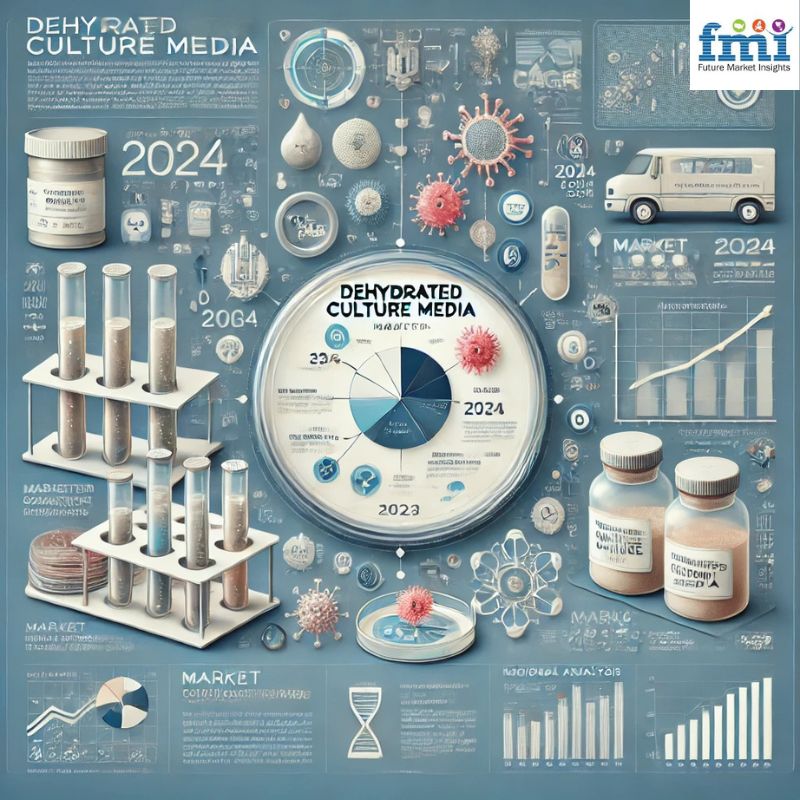
NEWARK, Del, Nov. 19, 2024 (GLOBE NEWSWIRE) -- The Dehydrated Culture Media Market is set to expand from USD 1,185.0 million in 2024 to a projected USD 2,398.3 million by 2034, at a steady compound annual growth rate (CAGR) of 7.3%. Dehydrated culture media, essential in microbial cultivation and diagnostic studies, is witnessing rising demand across clinical, pharmaceutical, and biotechnological applications. As the healthcare and diagnostics sectors expand, the market benefits from a growing need for high-quality, convenient, and stable culture media solutions.
Factors driving the growth of the dehydrated culture media market include increasing investments in biotechnology and life sciences, advancements in food safety protocols, and the rise of diagnostic procedures globally. These factors are fueling demand for reliable, long-lasting culture media, accelerating the market's development over the forecast period.
In particular, research in microbiology and pharmaceuticals has boosted demand for culture media used in cell culture, virus isolation, and microbial growth. The convenience of dehydrated culture media, along with its stable shelf life and ease of transport, positions it as a preferred option in laboratories and industrial applications.
With technological advancements enhancing the quality and stability of these media types, the Dehydrated Culture Media Market is poised to maintain a robust growth trajectory, catering to a broad array of applications within healthcare, research, and diagnostics.
Country-wise Insights
The industry analysis of the dehydrated culture media market for various nations is covered in the section below. Analysis of market demand is given for important nations in a number of global regions, such as Europe, Asia Pacific, North America, and others. The United States is expected to maintain its leadership position in North America and achieve a compound annual growth rate (CAGR) of 3.8% by 2034. By 2034, China is expected to grow at a CAGR of 7.6% in the
Asia Pacific region.
| Countries | Value CAGR (2024 to 2034) | |
| Canada | 2.8% | |
| UK | 3.6% | |
| France | 3.2% | |
| China | 7.6% | |
| Japan | 3.9% | |
| India | 6.9% | |
| Spain | 4.4% | |
Key Takeaways from Market Study
- The dehydrated culture media market is projected to grow at a 7.3% CAGR from 2024 to 2034, with significant traction across biotechnology and life sciences.
- The market is expected to reach a valuation of USD 2,398.3 million by 2034, driven by increased demand in healthcare and diagnostics.
- Technological advancements are improving the quality and stability of dehydrated culture media, enhancing product efficacy and convenience.
- Clinical diagnostics and food safety sectors are key growth drivers as they increasingly rely on microbial culture for pathogen detection.
“Dehydrated culture media offers remarkable advantages in stability, convenience, and quality for laboratories and research institutions,” notes an industry analyst. “As the demand for efficient microbial detection rises in both healthcare and industrial settings, manufacturers are encouraged to innovate in culture media solutions that meet diverse requirements in diagnostics, food safety, and environmental studies.” Says Sabyasachi Ghosh (Associate Vice President at Future Market Insights, Inc.)
Dehydrated Culture Media Market Opportunities
Emerging areas such as precision medicine, synthetic biology, and rapid microbiology testing are opening up day-by-day opportunities in the dehydrated culture media market. The adoption of automated microbial testing and advanced diagnostic techniques offers manufacturers a pathway to cater to highly specific market needs, fostering opportunities for niche product development and customization. Additionally, the increasing adoption of sustainable and vegan culture media options is broadening the market reach, encouraging more diverse applications across various industries.
Key Companies & Market Share Insights
Key players in the Dehydrated Culture Media Market include Thermo Fisher Scientific, Merck KGaA, Bio-Rad Laboratories, Inc., Becton, Dickinson and Company, and HiMedia Laboratories. These companies are actively investing in R&D to enhance product offerings, expand their application portfolio, and meet evolving regulatory requirements. Market leaders are also focusing on mergers, acquisitions, and partnerships to broaden their global reach and strengthen their position in emerging markets.
Regional Analysis of Dehydrated Culture Media Market
- North America: The largest market due to advanced healthcare infrastructure and significant investments in biopharmaceutical research.
- Europe: Driven by stringent food safety regulations and an emphasis on environmental microbiology.
- Asia-Pacific: Fastest-growing region, supported by rapid growth in healthcare and diagnostics, especially in China and India.
- Latin America: Increasing demand in clinical diagnostics and food safety sectors, enhancing market expansion.
-
Middle East & Africa: Growth fueled by healthcare advancements and growing investment in life sciences.
The Dehydrated Culture Media Market is on a growth path, supported by advances in diagnostics, regulatory demands in food safety, and innovative product developments catering to a wide array of applications. The market’s resilience and adaptability to emerging technologies promise sustained demand and continued progress through 2034.
A Full Report Analysis : https://www.futuremarketinsights.com/reports/dehydrated-culture-media-market
Competitive Landscape Overview
In the dehydrated culture media market, companies are increasingly focusing on new product launches, business expansion, and strategic partnerships to strengthen their global presence. Substantial investments are directed toward enhancing product offerings, ensuring higher quality, and expanding geographical reach.
Recent Developments:
- In July 2024, HiMedia Laboratories partnered with BioSynTech Malaysia to improve product availability across Malaysia.
- In November 2023, Thermo Fisher expanded its peptone manufacturing facility in the UK, focusing on delivering consistent, high-quality culture media products.
Key Players of Dehydrated Culture Media Industry
- Thermo Fisher Scientific Inc.
- Merck KGaA
- Becton, Dickinson and Company (BD)
- Bio-Rad Laboratories, Inc.
- bioMérieux S.A.
- Neogen Corporation
- Scharlab S.L.
- Hardy Diagnostics
- CONDALAB
- labm
- HiMedia Laboratories Pvt. Ltd.
- tmmedia.in (Titan Biotech Ltd.)
- Micromaster Laboratories Pvt. Ltd.
- Microxpress (Tulip Diagnostics Pvt. Ltd.)
- Bio-Novum Sp. z o.o.
- Cole-Parmer Instrument Company, LLC.
- Alliance Bio Expertise
- Th. Geyer GmbH & Co. KG
Key Segments of Dehydrated Culture Media Industry
By Media type:
In terms of media type, the industry is divided synthetic media (minimal media, defined media), general purpose media (nutrient agar, tryptic soy agar (TSA) and other general purpose media), differential media (MacConkey agar, blood agar, and eosin methylene blue (EMB) agar), anaerobic growth media (reinforced Clostridial medium, thioglycollate broth), specialty media (selective media, chromogenic media, mannitol salt agar), transport and storage media and enriched media.
By Application:
In terms of application, the industry is segregated into coronary dehydrated culture media, peripheral dehydrated culture media, urology dehydrated culture media, and radiology dehydrated culture media, neurovascular dehydrated culture media, gastroenterology dehydrated culture media and others.
By Form:
In terms of form, the industry is segregated into powder, granulated and liquid.
By Strain:
In terms of strain, the industry is segregated into Viral (Herpes Simplex Virus (HSV), Influenza Virus, Hepatitis Viruses and Other Viral Strains), Bacterial (Staphylococcus aureus, Streptococcus pneumoniae, Bacillus anthracis, Escherichia coli, Pseudomonas aeruginosa, Salmonella enterica, Mycobacterium tuberculosis and Other Bacterial Strains) Fungal (Candida albicans, Saccharomyces cerevisiae, Aspergillus niger, Penicillium notatum and Other Fungal Strains) and Others.
By End User:
In terms of end user, the industry is segregated into hospitals, clinical diagnostic laboratories, pharmaceutical and biopharmaceutical companies, academic and research institutions, food & water testing laboratories, biotechnology companies, contract research organizations (CROs) food and beverage industry.
By Region:
Key countries of North America, Latin America, East Asia, South Asia & Pacific, Western Europe, Eastern Europe and Middle East & Africa have been covered in the report.
German Translation
Der Markt für dehydrierte Nährmedien soll von 1.185,0 Millionen USD im Jahr 2024 auf voraussichtlich 2.398,3 Millionen USD im Jahr 2034 wachsen, bei einer stetigen durchschnittlichen jährlichen Wachstumsrate (CAGR) von 7,3 %. Dehydrierte Nährmedien, die für die mikrobielle Kultivierung und diagnostische Studien unverzichtbar sind, verzeichnen eine steigende Nachfrage in klinischen, pharmazeutischen und biotechnologischen Anwendungen. Mit der Expansion der Gesundheits- und Diagnostiksektoren profitiert der Markt von einem wachsenden Bedarf an hochwertigen, praktischen und stabilen Nährmedienlösungen.
Zu den Wachstumsfaktoren des Marktes für dehydrierte Nährmedien zählen steigende Investitionen in Biotechnologie und Biowissenschaften, Fortschritte bei Lebensmittelsicherheitsprotokollen und die weltweite Zunahme diagnostischer Verfahren. Diese Faktoren treiben die Nachfrage nach zuverlässigen, langlebigen Nährmedien an und beschleunigen die Entwicklung des Marktes im Prognosezeitraum.
Insbesondere die Forschung in den Bereichen Mikrobiologie und Pharmazie hat die Nachfrage nach Kulturmedien für Zellkulturen, Virusisolierung und mikrobielles Wachstum gesteigert. Die praktische Handhabung dehydrierter Kulturmedien sowie ihre stabile Haltbarkeit und einfache Transportierbarkeit machen sie zu einer bevorzugten Option in Laboren und industriellen Anwendungen.
Da der technologische Fortschritt die Qualität und Stabilität dieser Medientypen verbessert, ist der Markt für dehydrierte Kulturmedien auf einem robusten Wachstumskurs und deckt ein breites Anwendungsspektrum im Gesundheitswesen, der Forschung und der Diagnostik ab.
Wichtige Erkenntnisse aus der Marktstudie
- Der Markt für dehydrierte Kulturmedien soll zwischen 2024 und 2034 um durchschnittlich 7,3 % jährlich wachsen , wobei in den Bereichen Biotechnologie und Biowissenschaften eine erhebliche Dynamik zu verzeichnen sein dürfte.
- Aufgrund der steigenden Nachfrage im Gesundheits- und Diagnostikbereich dürfte der Markt bis 2034 einen Wert von 2.398,3 Millionen US-Dollar erreichen.
- Technologische Fortschritte verbessern die Qualität und Stabilität dehydrierter Kulturmedien und steigern so die Wirksamkeit und Benutzerfreundlichkeit der Produkte.
- Die wichtigsten Wachstumsmotoren sind die Bereiche klinische Diagnostik und Lebensmittelsicherheit, da sie sich bei der Erkennung von Krankheitserregern zunehmend auf mikrobielle Kulturen verlassen.
„Dehydrierte Kulturmedien bieten Laboren und Forschungseinrichtungen bemerkenswerte Vorteile in puncto Stabilität, Komfort und Qualität“, bemerkt ein Branchenanalyst. „Da die Nachfrage nach effizienter mikrobieller Erkennung sowohl im Gesundheitswesen als auch in der Industrie steigt, werden Hersteller ermutigt, innovative Lösungen für Kulturmedien zu entwickeln, die den vielfältigen Anforderungen in den Bereichen Diagnostik, Lebensmittelsicherheit und Umweltstudien gerecht werden“, sagtSabyasachi Ghosh (Associate Vice President bei Future Market Insights, Inc.).
Tägliche Marktchancen
Neue Bereiche wie Präzisionsmedizin, synthetische Biologie und schnelle mikrobiologische Tests eröffnen täglich neue Möglichkeiten auf dem Markt für dehydrierte Nährmedien. Die Einführung automatisierter mikrobiologischer Tests und fortschrittlicher Diagnosetechniken bietet Herstellern die Möglichkeit, auf hochspezifische Marktanforderungen einzugehen und Möglichkeiten für die Entwicklung und Anpassung von Nischenprodukten zu schaffen. Darüber hinaus erweitert die zunehmende Einführung nachhaltiger und veganer Nährmedien die Marktreichweite und fördert vielfältigere Anwendungen in verschiedenen Branchen.
Wichtige Unternehmen und Einblicke in die Marktanteile
Zu den wichtigsten Akteuren auf dem Markt für dehydrierte Kulturmedien zählen Thermo Fisher Scientific, Merck KGaA, Bio-Rad Laboratories, Inc., Becton, Dickinson and Company und HiMedia Laboratories. Diese Unternehmen investieren aktiv in Forschung und Entwicklung, um ihr Produktangebot zu verbessern, ihr Anwendungsportfolio zu erweitern und den sich entwickelnden gesetzlichen Anforderungen gerecht zu werden. Marktführer konzentrieren sich auch auf Fusionen, Übernahmen und Partnerschaften, um ihre globale Reichweite zu erweitern und ihre Position in Schwellenmärkten zu stärken.
Regionale Analyse des Marktes für dehydrierte Kulturmedien
- Nordamerika : Der größte Markt dank fortschrittlicher Gesundheitsinfrastruktur und erheblicher Investitionen in die biopharmazeutische Forschung.
- Europa : Angetrieben durch strenge Vorschriften zur Lebensmittelsicherheit und einen Schwerpunkt auf der Umweltmikrobiologie.
- Asien-Pazifik : Am schnellsten wachsende Region, unterstützt durch schnelles Wachstum im Gesundheitswesen und in der Diagnostik, insbesondere in China und Indien.
- Lateinamerika : Steigende Nachfrage in den Bereichen klinische Diagnostik und Lebensmittelsicherheit, was die Marktexpansion fördert.
-
Naher Osten und Afrika : Wachstum durch Fortschritte im Gesundheitswesen und steigende Investitionen in Biowissenschaften.
Der Markt für dehydrierte Nährmedien befindet sich auf Wachstumskurs, unterstützt durch Fortschritte in der Diagnostik, regulatorische Anforderungen an die Lebensmittelsicherheit und innovative Produktentwicklungen für ein breites Anwendungsspektrum. Die Widerstandsfähigkeit des Marktes und seine Anpassungsfähigkeit an neue Technologien versprechen eine anhaltende Nachfrage und weitere Fortschritte bis 2034.
Überblick über die Wettbewerbslandschaft
Auf dem Markt für Trockennährböden konzentrieren sich Unternehmen zunehmend auf die Einführung neuer Produkte, Geschäftserweiterungen und strategische Partnerschaften, um ihre globale Präsenz zu stärken. Erhebliche Investitionen fließen in die Verbesserung des Produktangebots, die Gewährleistung höherer Qualität und die Ausweitung der geografischen Reichweite.
Aktuelle Entwicklungen:
- Im Juli 2024 ging HiMedia Laboratories eine Partnerschaft mit BioSynTech Malaysia ein, um die Produktverfügbarkeit in ganz Malaysia zu verbessern.
- Im November 2023 erweiterte Thermo Fisher seine Pepton-Produktionsanlage in Großbritannien und konzentrierte sich dabei auf die Bereitstellung gleichbleibend hochwertiger Kulturmedienprodukte.
Hauptakteure der dehydrierten Kulturmedienindustrie
- Thermo Fisher Scientific Inc.
- Merck KGaA
- Becton, Dickinson und Company (BD)
- Bio-Rad Laboratories, Inc.
- bioMérieux SA
- Neogen Corporation
- Scharlab SL
- Hardy-Diagnostik
- KONDALAB
- labm
- HiMedia Laboratories Pvt. Ltd.
- tmmedia.in (Titan Biotech Ltd.)
- Micromaster Laboratories Pvt. GmbH.
- Microxpress (Tulip Diagnostics Pvt. Ltd.)
- Bio-Novum Sp. z oo
- Cole-Parmer Instrument Company, LLC.
- Allianz Bio-Expertise
- Th. Geyer GmbH & Co. KG
Author By
Sabyasachi Ghosh (Associate Vice President at Future Market Insights, Inc.) holds over 12 years of experience in the Healthcare, Medical Devices, and Pharmaceutical industries. His curious and analytical nature helped him shape his career as a researcher.
Identifying key challenges faced by clients and devising robust, hypothesis-based solutions to empower them with strategic decision-making capabilities come naturally to him. His primary expertise lies in areas such as Market Entry and Expansion Strategy, Feasibility Studies, Competitive Intelligence, and Strategic Transformation.
Holding a degree in Microbiology, Sabyasachi has authored numerous publications and has been cited in journals, including The Journal of mHealth, ITN Online, and Spinal Surgery News.
Explore FMI's Extensive Coverage in the Healthcare Domain:
The global sales of contrast media injectors is estimated to be worth USD 4,949 million in 2024 and anticipated to reach a value of USD 8,832.8 million by 2034.
Global cell culture media bag market is expected to be valued at US$ 1,308.7 million in 2023 and to reach a valuation of US$ 3,541 million by 2033.
The 3D cell culture market size is projected to be worth US$ 1.26 billion in 2023. The market is likely to reach US$ 3 billion by 2033.
The global sales of veterinary endoscopes are estimated to be worth USD 286.9 million in 2024 and are anticipated to reach a value of USD 625.3 million by 2034.
The global sales of reconditioned dental microsurgery is estimated to be worth USD 348.0 million in 2024 and are anticipated to reach a value of USD 678.1 million by 2034.
The multiplex biomarker imaging market is expected to be valued USD 585.0 million in 2024 and USD 1,631.4 million by 2034.
The global sales of robotic wheelchair are estimated to be worth USD 157.4 million in 2024 and anticipated to reach a value of USD 451.1 million by 2034.
The global sales of dental sutures are estimated to be worth USD 537.1 million in 2024 and anticipated to reach a value of USD 970.9 million by 2034.
The global sales of RFID blood monitoring systems is estimated to be worth USD 127.4 million in 2024 and anticipated to reach a value of USD 234.7 million by 2034.
About Future Market Insights (FMI)
Future Market Insights (FMI) is a leading provider of market intelligence and consulting services, serving clients in over 150 countries. FMI is headquartered in Dubai and has delivery centres in the United Kingdom, the United States, and India. FMI's latest market research reports and industry analysis helps businesses navigate challenges and make critical decisions with confidence and clarity amidst breakneck competition. Our customized and syndicated market research reports deliver actionable insights that drive sustainable growth. A team of expert-led analysts at FMI continuously tracks emerging trends and events in a broad range of industries to ensure that our clients prepare for the evolving needs of their consumers.
Join us as we commemorate 10 years of delivering trusted market insights. Reflecting on a decade of achievements, we continue to lead with integrity, innovation, and expertise.
Contact Us
Future Market Insights Inc.
Christiana Corporate, 200 Continental Drive,
Suite 401, Newark, Delaware - 19713, USA
T: +1-347-918-3531
For Sales Enquiries: sales@futuremarketinsights.com
Website: https://www.futuremarketinsights.com
LinkedIn| Twitter| Blogs | YouTube


Legal Disclaimer:
EIN Presswire provides this news content "as is" without warranty of any kind. We do not accept any responsibility or liability for the accuracy, content, images, videos, licenses, completeness, legality, or reliability of the information contained in this article. If you have any complaints or copyright issues related to this article, kindly contact the author above.
